
Population Ecology
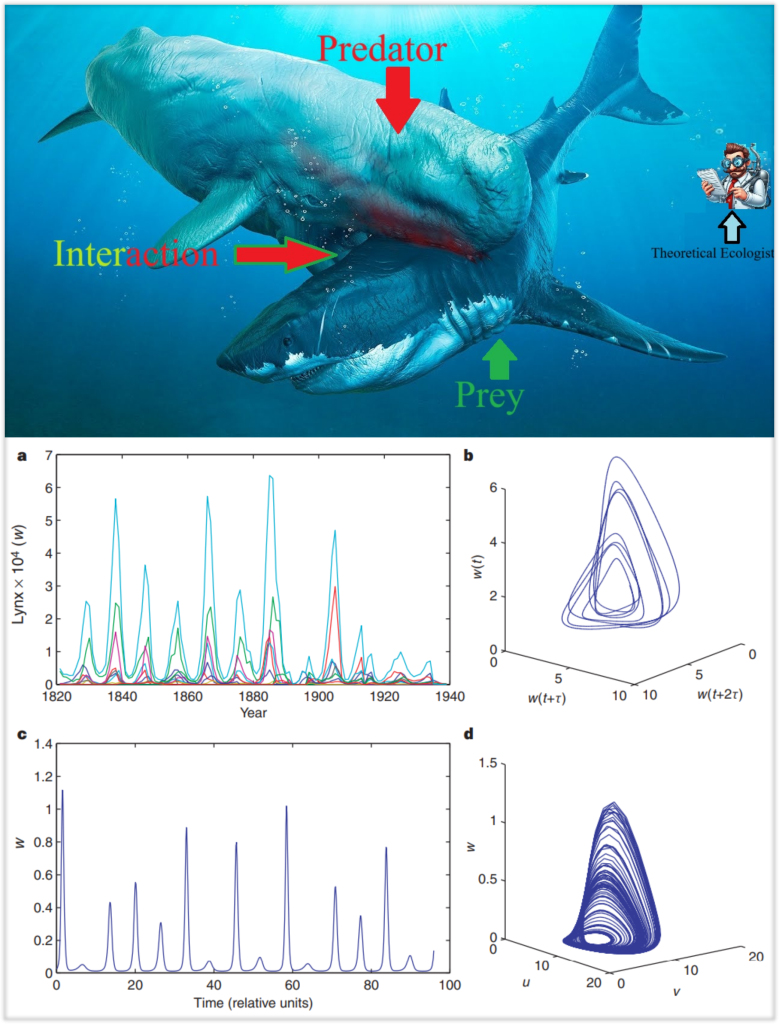
Population ecology is a cornerstone of computational biology and theoretical ecology, dealing with the biodiversity and persistence of an ecosystem primarily through the lens of spatio-temporal species population dynamics. Specific essential parameters, particular to the ecosystem in question, govern the population dynamics of an ecosystem and thus majorly influence the extinction risk of ecosystems. Such parameters quantify biotic and abiotic phenomena like the death rate of a species, the birth rate of a species, immigration, emigration, trophic and non-trophic interspecies and intraspecies interactions, as well as eco-environmental interactions, like climate change, habitat loss, and human influence. Factoring in these parameters, the population dynamics of ecosystems are described by prey-predator models, which are essentially nonlinear and can be analyzed using the robust structure of nonlinear dynamics. This fundamentally ‘physical’ approach to theoretical ecology has resulted in several remarkable observations and predictions (e.g., Figure 1. From Blasius and Stone, 1991). Not only do these models exhibit features of traditional nonlinear dynamics like chaoticity, but we can extend them readily to construct complex networks of food -webs ( i.e., multi-species oscillator models), which accurately describe the intricacies of a natural ecosystem. We live in ecosystems, and understanding what keeps them alive is what keeps us alive, and NLD can help us keep it that way.